

GIG WORKERS IN THE REGION
The latest regional Gigmetar has found restructuring of the digital labour market is picking up speed. In addition to a large-scale contraction in the supply of gig labour, the latest trends include a decline in the market share of Upwork, the largest regional gig work platform, which was accompanied by a marked increase in the gig workforce active on Freelancer and stagnation on Guru. The structure of the workforce has skewed towards less sophisticated occupations, with clerical and data entry the only area to see an increase in worker numbers.Read more ...
Gender trends were dissimilar: a slight increase in women freelancers was paralleled by a major decline in the male population, which narrowed the platform participation gap, whilst incomes fell more for men than for women. That being said, gender-based differences in hourly rates varied by country. Overall, the changes were driven by both national and global factors, which ultimately resulted in regressive trends.
The region’s digital labour market has been evolving in a global environment fraught with uncertainty, in spite of some favourable developments relative to earlier in the year. The International Monetary Fund (IMF) has forecast an increase in global growth to 3.1 percent, mainly due to less regulatory volatility in foreign trade and, crucially, in the US, the world’s major gig work market. Nevertheless, emerging markets are projected to see far higher growth (at 3.1 percent) than mature ones (1.5 percent), creating little additional potential for greater demand for gig work services. Moreover, the Vienna Institute for International Economic Studies (WIIV) has found that, in spite of uncertainty, the region’s countries have been registering high growth rates, further reducing the supply of gig work in global digital labour markets. According to the European Bank for Reconstruction and Development (EBRD), in most countries inflationary trends are above projected central bank figures and above key market averages when it comes to the supply of gig work; coupled with the registered decline in potential incomes in global digital labour markets and the close ties between most regional currencies and the euro, these developments have made gig work less attractive. Whereas most employment trends are positive, regional labour markets remain hampered by structural inefficiencies such as high inactivity rates, out-migrations of young people, and a lack of relevant skills. Uncertainty in the tech sector, which the 2025 WIPO report finds reflected in falling investment in innovation, has been having knock-on effects that include lower demand for services connected with digital content creation and high tech products, which has, consequently, depressed global demand for gig worker services. Robust innovation performance throughout the region has, by contrast, laid the groundwork for greater demand in conventional labour markets, also driving down labour supply in global gig work platforms. The potential gig labour supply is also affected by the pace of digitalisation throughout the region. Relatively limited digital skills, including in EU member states such as Bulgaria and Romania, pose a structural barrier that has been hindering large-scale participation in the digital labour market. Conversely, the limited use of technology by businesses has been a factor behind the fairly high degree of development of the region’s gig work market, as it has restricted demand for freelancer services nationally, thereby boosting supply on global digital platforms. Future developments, especially a shift to more tech use by companies, could limit the supply of gig work in the medium term. The ultimate outcome will depend on the interaction of national, global, and platform-specific factors shaping the market.
As early as the latter half of 2025, the interplay between these aspects led to a decline in the regional freelancer population active on global platforms, with expectations for the coming year centring on major uncertainty in business, technology, and regulatory environment, both at home and abroad.
HIGHLIGHTS

Decline in gig labour supply accompanied by market restructuring. This was the fifth consecutive period to see a decline in the total gig workforce, albeit a relatively minor one (at 0.7 percent), with robust growth of labour supply on Freelancer (at 17.5 percent), coupled with a much more modest increase on Guru (0.6 percent), offsetting the fall on Upwork (at -7.7 percent).
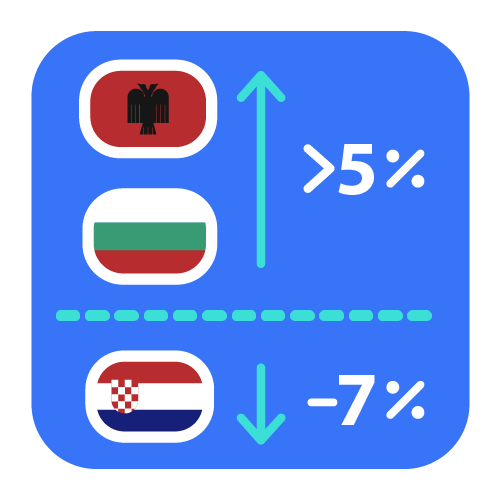
Countries bucking the trend. Albania and Bulgaria experienced an increase in their gig workforces of more than 5 percent, as did Romania, which saw less pronounced growth at 1.4 percent. Croatia fared the least well, with 7 percent of all gig workers leaving the country’s market.

Fall in Upwork’s market share. Even though Upwork was still able to attract more than one-half (or 51.7 percent) of the entire freelancer workforce, its market share has fallen by 4 percentage points (pp), the largest individual change in the structure of the market since these measurements first began.

Workforce structure skewing towards less sophisticated occupations. The fairly robust increase (at 13.2 percent) of the freelancer workforce in clerical and data entry was accompanied by a major contraction in the technically most sophisticated occupations, creative and multimedia and software dev and tech, which accounted for eight of every 10 gig workers who left the digital labour market over the past six months
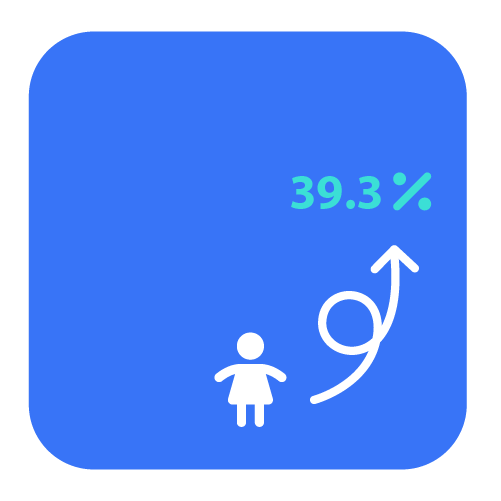
Women increasing their presence in the digital labour market. The relatively significant decline in the male workforce (at -7.2 percent), coupled with a slight increase in the share of women (1.1 percent), has boosted women’s participation in the total freelancer population to 39.3 percent.

Shift in posted hourly rates [1]. After having grown for several years, posted hourly rates have now fallen by 2.4 percent. North Macedonia provided the sole exception, as hourly rates there have edged up (by 0.2 percent), with Albanian freelancers seeing the largest contraction of -6.6 percent relative to the previous measurement.
[1] ‘Hourly rates’, indicating the asking price of labour posted by gig workers on their online accounts, is used in Gigmetar interchangeably with ‘earnings’.
LEADING PLATFORMS
The latest measurement has revealed the fifth consecutive decline in the freelancer population of Southeastern Europe, but the drop was nonetheless minimal at 0.7 percent.
Upwork has remained the region’s leading platform, even though its share has fallen by 4 pp to 51.7 percent. In parallel, the remaining two platforms have continued adding workers, with Freelancer registering major growth at 17.5 percent, and Guru seeing a far more moderate increase of 0.6 percent. Read more ...
Two up, one down. In contrast to the major growth experienced by Freelancer and the much less dramatic increase of the freelancer workforce on Guru, Upwork has seen the third consecutive fall in its worker numbers, of 7.7 percent. In the market as a whole, however, this decline was nearly offset by the growth of Freelancer and Guru, so that the total freelancer workforce recorded a minimal contraction. Even though Upwork’s decrease was greater than that seen in the previous survey, this platform has retained its dominant position in the region, claiming first place in all countries, albeit with significant variations, ranging from a market share as high as 65.7 percent in Albania to no more than 40.7 percent in Romania.
Shifting market structure. The dissimilar developments on the three platforms have meant that Upwork’s market share has fallen to slightly under one-half, with each of the remaining two platforms claiming nearly equal portions: 23.1 percent of the regional freelancer workforce was active on Freelancer, whilst Guru attracted 25.2 percent of all gig workers.
Limitations affecting outlook projections. Multiple factors may have affected the accuracy of these estimates. Firstly, there has been a change in the methodology of how gig workers are presented on the various platforms, and, with the procedure not publicly available, the different reports may not be directly comparable. Secondly, the same gig workers may have had multiple profiles on different platforms (a practice known as multihoming). The latter issue is not as significant since platforms have an interest in presenting only active workers available to potential employers and therefore update their gig worker databases fairly regularly. As such, even though some workers have profiles open on more than one platform, this does not affect estimates of the actually available workforce, since all those workers are active.
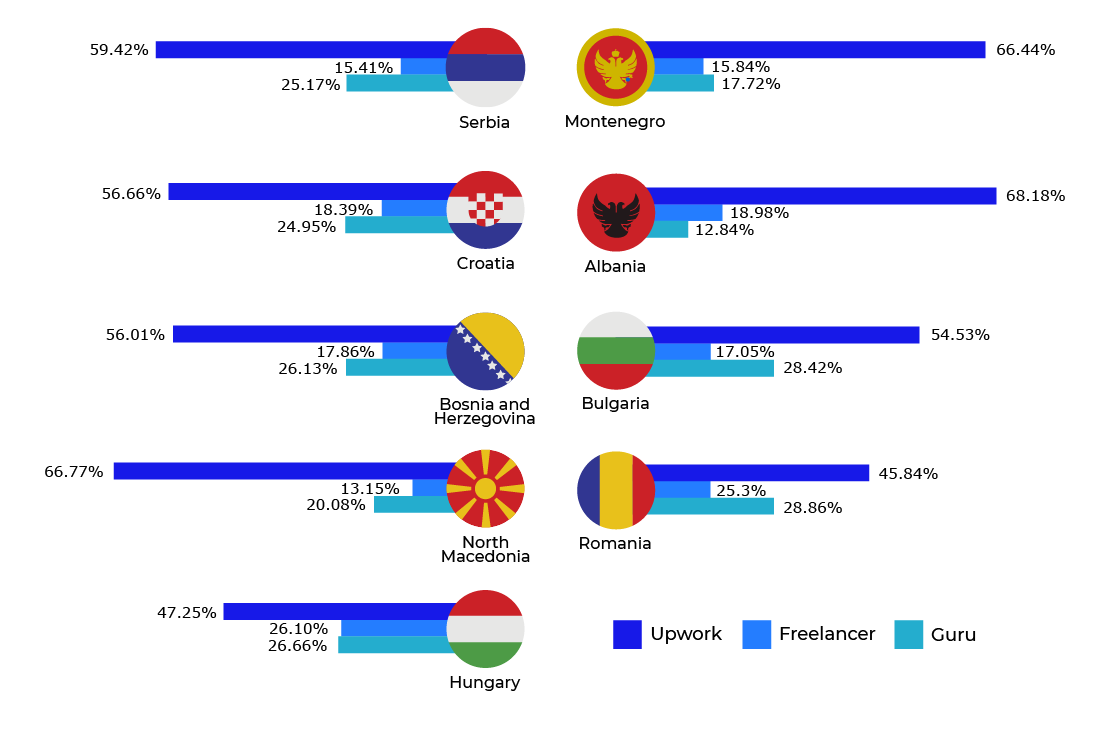
SHARE OF GIG WORKERS BY COUNTRY AS % OF REGIONAL TOTAL
Bulgaria, Albania, and Romania were the sole countries in the region to see their overall freelancer populations increase, whereas Albania and Bulgaria were the only ones to register growth across all platforms. Croatia was the greatest relative loser and the only country to record a decline in its gig workforce on both Upwork and Freelancer. The greatest loser in absolute terms was Serbia, where close to 1,000 gig workers left the online market in the past six months. Read more ...
Dissimilar trends across countries. Most countries saw their gig workforces decline, but the fall was not as pronounced everywhere. Croatia saw the largest downturn (at 7 percent), followed by North Macedonia (5.3 percent) and Serbia (4.4 percent), whilst Montenegro saw a far more modest decrease (at 1.9 percent). The gig worker populations of Bosnia and Herzegovina and Hungary remained nearly unchanged, having registered a decline of under 1 percent. Conversely, the final three countries saw growth, at more than 5 percent in Bulgaria and Albania, and a far less noticeable 1.4 percent in Romania, whose large size makes it particularly difficult to add new gig workers.
From negligible growth to increases comparable to the covid era. Most countries registered minimal changes on Guru, as growth failed to exceed 1 percent, with the exceptions of Albania (1.1 percent) and Montenegro (2.6 percent). Conversely, the developments were positive and much more visible on Freelancer, although not all countries registered the same growth. In Albania, Bulgaria, and Romania, freelancer populations increased by more than one-fifth, although double-digit growth was also recorded in Serbia (at 18.7 percent), Bosnia and Herzegovina (17.6 percent), Hungary (13.9 percent), and North Macedonia (11.7 percent). Montenegro experienced the smallest growth (at 8.3 percent), and Croatia was the only country to see its gig worker population on Freelancer edge down (by -1.3 percent). Although the majority of the region’s countries saw a decline in their gig populations on Upwork, Albania and Bulgaria bucked this trend by registering growth of 1.5 and 3.9 percent, respectively. For the remaining countries, the contraction amounted to 9.2 percent on average. Most markets saw comparable downward rates, suggesting that platform-specific factors likely drove the latest developments and that some freelancers may have moved from Upwork to the other global online platforms.
Asymmetric workforce distributions by country. The latest changes, coupled with country size, have caused some shifts in the relevant importance of the region’s national markets. The findings of this survey have cemented Romania’s dominance as the largest gig work supplier, now home to one in four of the region’s freelancer workforce. Serbia was the only other country with a similarly sizeable share, at 23 percent, with all other markets reporting significantly lower figures, ranging from 1.9 percent in Montenegro to 10.8 percent in Bulgaria.
NUMBER OF GIG WORKERS PER 100,000 POPULATION, BY COUNTRY
The continuing gig work contraction across most of the region meant the workforce continued to fall, reaching a new post-pandemic low of 88,948 active gig workers in the latest survey.
Given the size of the countries and the total freelancer workforce, the overall changes were quite small. The latest survey found on average 159 freelancers per 100,000 population in the region. However, the relative size of the gig worker population did decline throughout the region, except in Bulgaria, where it remained unchanged. Despite having traditionally the largest gig workforce relative to its size, North Macedonia registered the greatest fall in this regard, by as many as 67 freelancers per 100,000 inhabitants. Nevertheless, the country was still able to boast by far the region’s largest workforce of 266 gig workers per 100,000 population.Read more ...
Major differences between countries. The region’s countries can be divided into three groups, each with a different ratio between gig workforce and total population. The first category, comprising Hungary, Romania, Bulgaria, Croatia, and newcomer Bosnia and Herzegovina, registered below 100 freelancers per 100,000 population, for an average of 64. In the second group, made up of Serbia, Montenegro, and Albania the ratio was relatively high, ranging from 175 and 176 per 100,000 population in Montenegro and Albania, respectively, to 162 in Serbia. North Macedonia was an outlier, boasting by far the highest ratio of gig workers to inhabitants of 239 per 100,000 population.
Between downturn and stagnation. The ratio of freelancers to total population fell in all countries save Bulgaria, where the figure remained unchanged. The remaining markets registered a contraction by a minimal 11 on average, with the exception of North Macedonia, where the ratio fell by as much as in all other countries combined, at 67 gig workers per 100,000 population.
REGIONAL GIG WORKERS BY PROFESSION
The latest survey of the digital labour market found a fresh downturn in the online freelancer population. Even though Upwork, the largest online platform, lost workers overall, it added new freelancers in clerical and data entry, where the population rose by 13.2 percent. All other occupations declined, with the exception of professional services where the numbers remained virtually unchanged. The two most numerous occupations, creative and multimedia and software dev and tech, were also the most severely affected, falling by 7.2 and 8.6 percent, respectively, and so continuing the downward trend identified in the previous survey.
The engagement rate for regional freelancers stood at slightly above one-third (33.9 percent) of the active population at the time of the survey, albeit with major national variations. Albania could boast the fewest gig workers engaged (24.1 percent), whilst North Macedonia recorded the most active freelancer population, with 42 of every 100 being engaged at the time of the measurement. Read more ...
Clerical and data entry gaining in importance, with professional services stagnating and other occupations in decline. The latest survey has detected changes, albeit minor ones, in the distribution of gig workers by occupation. The growth in the relative importance (or share) of clerical and data entry freelancers was driven by the major expansion of the occupation, which ballooned by 13.2 percent. conversely, the share of professional services occurred as this occupation stagnated whilst others contracted appreciably. The most numerous occupations, software dev and tech and creative and multimedia, tended to see the largest downturn, with contractions here amounting to 8.6 and 7.2 percent, respectively, whilst sales and marketing support also fell by 6.4 percent. Writing and translation registered the smallest decline (at 4 percent). The relative changes were minimal, ranging from an increase in the share of clerical and data entry by 2 pp to a fall in the share of software dev and tech of -1.2 pp. For the first time since Gigmetar began tracking the occupational structure of the digital labour market, the share of software dev and tech has fallen to below one-quarter of the total workforce.
Engagement rates remain stable. At the time of the measurement, more than 15,379 gig workers were actively engaged on Upwork, making the online platform the equivalent of the region’s largest multinational corporation by workforce size. Quite apart from the impressive engagement rates in both relative and absolute terms – with on average more than one in three gig workers (33.9 percent) active at any given time – the findings also constituted an improvement on the previous survey, as the engagement rate grew by 1.9 percent. These results are all the more important given the fall in demand on Upwork, where the number of annual active clients fell by 70,000 in 2025, a contraction of 8.1 percent relative to 2024, as competition grew increasingly fierce, with over 18 million freelancers competing for five million jobs every year. The findings also corroborate the assumption that regional gig workers do have the required knowledge and skills, with ever greater numbers able to find work despite adverse demand trends.
Continuity evident despite persistent major differences. The large disparities in engagement rates identified in past measurements have remained. In spite of its traditionally high proportion of freelancers actively engaged at the time of the survey, Serbia has remained the sole country where fewer gig workers were engaged in this measurement compared to the previous round, with the proportion falling from 42.6 to 39 percent. North Macedonia boasted the highest rate, of 41.5 percent, with Montenegro a close second at 38.9 percent. Albania’s freelancer workforce has remained the least engaged at the time of the survey (at 24.1 percent), but even here the rate has grown by 2.5 pp, making Albania and Bulgaria (where the rate was 27.5 percent) the only countries where less than 30 percent of the freelancer population were engaged at the time the measurement took place. Moreover, all countries except Serbia saw their engagement rates increase, with growth ranging from 22.1 percent in Hungary to 6.5 percent in North Macedonia (despite a fall in the overall population), suggesting that countries with hitherto untapped potentials for gig work have been increasingly drawing on these opportunities, and that the region does possess a high-quality workforce that has been able to access the shrinking base of clients across the globe despite challenges and uncertainty.
REGIONAL GIG WORKERS BY COUNTRY AND PROFESSION
National markets have found different ways to adapt to the shrinking supply of freelancers in most countries, in particular in terms of occupational structure.
Whereas Albania, Montenegro, and Hungary registered the greatest changes to their structure of occupations, Croatia and North Macedonia saw the smallest differences relative to the previous measurement. North Macedonia and Bulgaria revealed the most idiosyncratic occupational structures that diverged to the greatest extent from the regional average. For instance, Bulgaria had an unusually small population of clerical and data entry freelancers, whilst in North Macedonia the software dev and tech workforce was also unexpectedly minimal. Read more ...
Bulgaria and Albania proved to be exceptions. All countries saw contractions in the supply of gig labour save Bulgaria and Albania, where the freelancer populations grew by 3.2 and 1.6 percent, respectively. However, the decline was not equally pronounced in all remaining countries. Serbia, Croatia, and North Macedonia all registered double-digit dips, at -13, -12.3, and -10.4 percent, respectively. A similar but single-digit decline was seen in Romania (at -9.3 percent), followed by Hungary (-8.3 percent), whilst in Bosnia and Herzegovina (-6.1 percent) and Montenegro (-5.5 percent) the dip was the least pronounced.
Identical trends across occupations in different countries. Bulgaria was the only market to see growth in gig workers across the board. By far the largest increase was recorded by clerical and data entry, with 4 out of 10 freelancers in this occupation being new entrants. By contrast, North Macedonia registered a contraction in all occupations, with writing and translation shedding most freelancers (-16.9 percent) and professional services declining the least (at -1.8 percent). Croatia also saw negative trends in all occupations, but to a lesser extent than North Macedonia. Here, the largest drop was seen in software dev and tech (-16.9 percent), and the smallest in clerical and data entry (-1.8 percent).
Dissimilar trends across occupations in different countries. The remaining markets showed exceptionally diverse developments across occupations, with differences in both contraction rates and occupations affected. Broadly, the countries can be divided into two groups, with, in the first, occupations that saw growth outnumbering those that contracted. In this category, Montenegro saw a decline only in professional services (-6.3 percent) and sales and marketing support (-11.4 percent), whereas Albania and Hungary registered a fall in the same number of occupations that registered growth; Albania saw its greatest contraction in sales and marketing support (-8.6 percent), whilst for Hungary the impact was highest on writing and translation (-11.6 percent). The second group comprised countries where more occupations declined than grew, namely Serbia, Bosnia and Herzegovina, and Romania. In the former two markets, expansion was seen in professional services (by 4.9 percent in Serbia and 13.8 percent in Bosnia and Herzegovina) and clerical and data entry (by 13.4 percent in Serbia and 5.9 percent in Bosnia and Herzegovina). Clerical and data entry was the sole occupation that added freelancers in Romania, at a rate of 14 percent.
Professional services, the smallest occupation, saw the most divergent developments. Growth was recorded in Albania, Bulgaria, Hungary, Serbia, and Bosnia and Herzegovina, where the increase was the greatest at 13.8 percent. The remaining four countries, namely Croatia, Montenegro, North Macedonia, and Romania, all saw their freelancer populations contract at an average rate of -9.8 percent.
Clerical and data entry has grown, but with exceptions. Although this was the sole occupation to register significant growth across the region (with 820 new workers entering the market), a major contraction in this field was nevertheless apparent in North Macedonia, at -9.6 percent, with Croatia showing a similar but far less pronounced trend at -1.8 percent.
Adverse developments dominated the remaining four occupations. Sales and marketing support fared the worst, with only Bulgaria seeing growth in this area (at 23.4 percent). Apart from Bulgaria, Montenegro was the only country to register an increase in creative and multimedia, whilst the remaining two occupations, software dev and tech and writing and translation, grew in three countries each. Here, writing and translation grew in Albania, Bulgaria, and Montenegro, increasing at a far greater rate (20 percent) than software dev and tech (3.4 percent), which expanded in Bulgaria, Montenegro, and Hungary.
National responses to global challenges. Responses by local digital labour markets across occupations suggest that most developments seen in the latest measurement were driven by shifts in global demand for labour. Since this is the second consecutive survey to identify this trend, it may suggest national digital work markets are maturing. In the future, local factors will increase in importance in the absence of major external shocks, so national labour markets will show far less similarity and will be shaped by issues such as the state of conventional labour markets and the sophistication of freelancer skills.
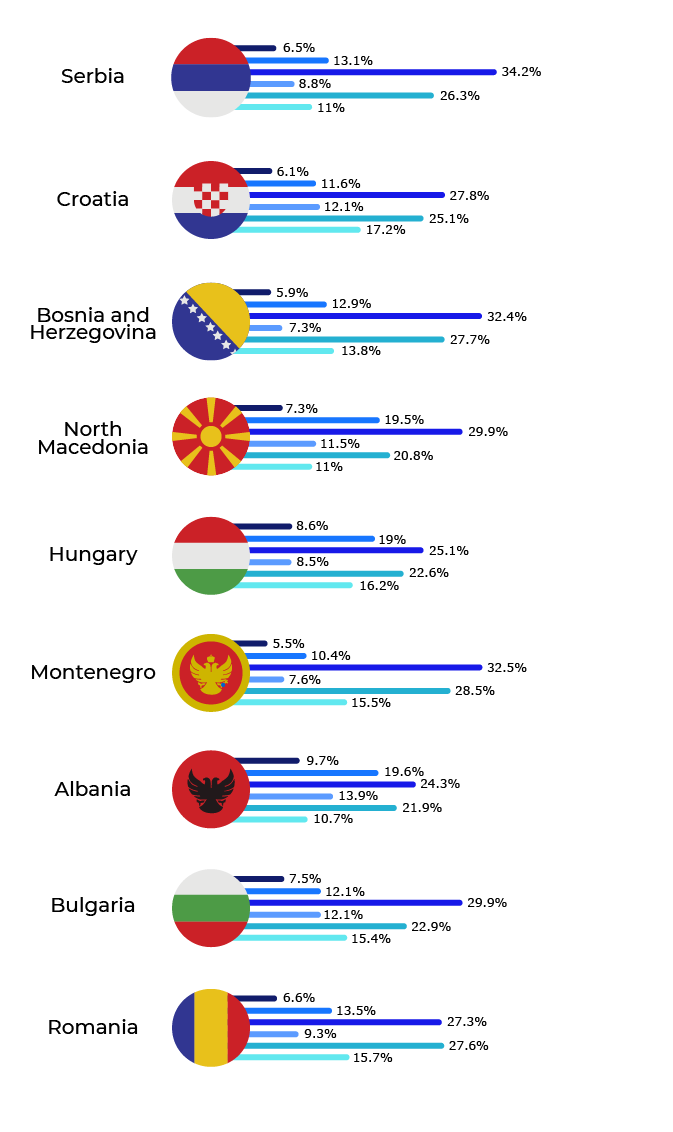
Comparative advantages of the countries in certain professions
A comparison of the relative share of an occupation in a particular country with its regional average can be used to identify the comparative advantages enjoyed by that country. The largest relative share of an occupation in a country suggests that country has an absolute comparative advantage in the regional context, whereas the share of an occupation in a country relative to the regional average indicates a relative comparative advantage.
In part due to an increase in its workforce, Albania increased its comparative advantage in professional services, with a share of 9.7 percent and sales and marketing support (13.9 percent), whilst also now achieving an advantage in clerical and data entry (19.6 percent). Bosnia and Herzegovina, Croatia, Hungary, and Montenegro all enjoyed comparative advantages in three occupations. Whilst Bosnia and Herzegovina, Croatia, and Hungary saw no major changes relative to the previous survey, Montenegro added writing and translation (with a share of 15.5 percent) to its list of occupations with comparative advantages that had previously comprised creative and multimedia (32.5 percent) and software dev and tech (28.5 percent).
North Macedonia and Bulgaria had the most distinctive labour supply structures anywhere in the region, as reflected in as many as four occupations in which they boasted comparative advantages. For North Macedonia, these were professional services, clerical and data entry, creative and multimedia, and sales and marketing support, but the comparative advantages were less pronounced than in the previous measurement, suggesting that the contraction has led to the structure of labour supply in this country to converge with the regional average. Bulgaria had previously registered comparative advantages in professional services, sales and marketing support, and writing and translation, and has now added creative and multimedia to this list.
Romania and Serbia shared the most similarities in their freelance workforces, due in part to their dominant position on the regional digital labour market. These two countries could boast comparative advantages in only two occupations: for Serbia these were creative and multimedia (34.2 percent) and software dev and tech (26.3 percent), whilst for Romania these were, traditionally, software dev and tech (27.6 percent) and writing and translation (15.7 percent).
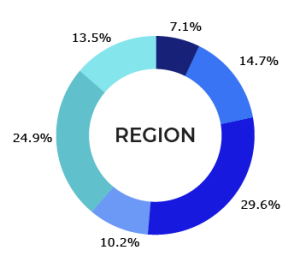

REGIONAL GIG WORKERS BY GENDER
The rather large decline in the number of men freelancers (at 7.2 percent), coupled with the growth in the women’s gig workforce (of 1.1 percent), has again increased the share of women in the total population, this time to 39.3 percent.
Nevertheless, four countries saw women expand their presence, whilst five registered a contraction. The greatest increase was recorded in Bulgaria, where the women’s workforce increased by more than one-fifth, whereas the greatest drop was seen in North Macedonia, by -9.6 percent.
Conversely, men became more numerous only in Bulgaria (13 percent) and Montenegro (4.4 percent). Double-digit contractions in the male freelancer population were seen in North Macedonia (-13 percent), Croatia (-11.8 percent), and Romania (-11.3 percent).
Women significantly increased their presence in clerical and data entry (by 31.2 percent) and writing and translation (23.3 percent) and also had a minimal numerical advantage in professional services (9.1 percent). Although the gap has been narrowing, men outnumbered women in the remaining three professions, sales and marketing support (by 17.8 percent) and creative and multimedia (63.5 percent), whilst the gender gulf in software dev and tech has remained broad, with men outnumbering women by a factor of 5.5. Read more ...
Share of women has increased. The latest survey has found the gender gap has narrowed significantly, with the share of women in the South-Eastern European countries surveyed increasing from 37.3 to 39.3 percent. This represents the continuation of the upward trend seen in the previous measurement, but with an even more pronounced increase in the relative importance of women freelancers in the latest survey. In addition, this development reflects the long-term development trajectory of the digital market, which is characterised by a consistent contraction of the gender gap. The 2 pp increase in the share of women was the result of the combined effect of a slight increase in the female workforce (by 1.1 percent) and the fall of the male population (by 7.2 percent). In other words, even though 2,030 people in total left the digital labour market, more than 200 women entered it, whilst in excess of 2,200 men exited. This result suggests that the regional women’s participation rate has for the first time exceeded the global average for Upwork, where women account for 38.6 percent of the total workforce.
Dissimilar gender developments by country. Three groups of countries can be identified in terms of gender trends. In the first category, countries that saw growth in both the male and the female freelancer populations were Bulgaria and Montenegro, with the former seeing its female workforce increase by as much as 20.6 percent and its male freelancer population by 13 percent, and the latter registering growth rates of 11.3 and 4.4 percent, respectively. The second group was made up of countries where more women freelancers entered the market (with their growth rates standing at 10 percent in Albania and 8.8 percent in Hungary) whilst more men exited (-6 percent in Albania and -2.7 percent in Hungary). The remaining five countries registered a simultaneous contraction of both their male and female freelancer populations, but the male workforce fell faster. The deepest (double-digit) contractions amongst men were seen in North Macedonia (-13 percent), Croatia (-11.8 percent), and Romania (-11.3 percent), whilst the women’s gig workforce declined across the board at single-digit rates, with the steepest drop seen in North Macedonia and Croatia, at -9.6 and -9.5 percent, respectively.
Some occupations contracted mainly due to global factors. Creative and multimedia, sales and marketing support, and software dev and tech were the only occupations to see a decline in both the male and female workforce. In creative and multimedia, women were down 3.7 percent, with larger contractions observed in sales and marketing support (-6.6 percent) and software dev and tech (-5.1 percent). The men’s population declined appreciably in creative and multimedia and software dev and tech, both at -9.2 percent each, whereas in sales and marketing support the contraction was comparable to that seen by women (at -6 percent), although slightly less pronounced. Clerical and data entry saw growth for both genders, with the women’s workforce surging by 18.7 percent whilst men’s increased by 6.9 percent. That all occupations recorded changes in identical directions, be they positive or negative, suggests the contraction or expansion was driven primarily by global factors. Given the increasing importance of gig workers and growing demand for their services, declining workforces in some occupations may have been caused largely by lower price competitiveness of gig workers from the region, employers’ geographical preferences who prefer to hire freelancers from their domestic markets, and growing competition between platforms, with freelancers moving from Upwork to other online marketplaces either in search of more accessible work or due to price incentives such as lower platform fees and falling hourly rates.
Other occupations declined due to an interplay of national and global drivers. The remaining two occupations, professional services and writing and translation, showed significant and clear differences across genders. Here, the changes worked in the opposite directions, with women adding 1.5 percent in professional services and 1.1 percent in writing and translation. Conversely, the male freelancer population fell by 2.2 percent in professional services and 9.5 percent in writing and translation. The various countries of the region also recorded highly idiosyncratic developments, indicating that digital labour markets were shaped by nationally specific factors and the local context, with global trends having only a secondary impact.
HOURLY RATES, IN US$
The slowdown in the market was the most clearly evidenced by the decline in average hourly rates. After several years of growing service prices, the region saw freelancers’ hourly rates fall by 2.4 percent.
North Macedonia, however, has bucked the regional trend, as its hourly rates edged up by 0.2 percent. Moreover, the contraction was not identical everywhere, with the smallest dip (at below -1 percent) registered in Montenegro and Croatia, and the largest (at -6.6 percent) seen in Albania; elsewhere it ranged from -3.9 percent in Bosnia and Herzegovina to -2.2 percent in Serbia. Croatian and Bulgarian freelancers were the best paid in the region, with an average posted hourly rate of more than US$26, whilst gig workers from North Macedonia and Albania could earn the least, with these two countries being the only ones where freelancers made less than US$20 per hour.
From a gender perspective, women’s incomes fell more (by -3.4 percent) than those of men (-1.3 percent), which widened the gender pay gap. Due to these developments, the latest survey has found women now earn 81.3 percent of what men are able to make per hour. Nevertheless, differences between countries have persisted, with the gender gap narrowing appreciably in Bulgaria, which has made the country the region’s most gender-balanced markets. By contrast, the gulf between genders has remained the widest in Hungary and North Macedonia, where women could make no more than 76.2 percent of the average hourly rates commanded by men.Read more ...
Posted hourly rates continue to decelerate. The regional decline in posted hourly rates was a departure from the upward trend seen over the past several surveys. The developments were almost identical throughout the region, with the exception of North Macedonia, where the average posted hourly rates edged up by 0.2 percent. Croatia and Montenegro saw dips of 0.8 and 0.4 percent, respectively, whilst Albania and Bosnia and Herzegovina registered the largest contractions, at 6.6 and 3.9 percent, respectively. In absolute terms, the decline in hourly rates was appreciable and economically significant only in Albania, where it amounted to US$1.4, reducing freelancer monthly income by some US$250, assuming they worked full time for the average hourly rate.
Croatia boasts highest average incomes. Even though countries registered dissimilar income growth rates, these were insufficient to change their relative positions but did result in some shifts. Here, although Croatia recorded the highest average hourly rates of US$26.8, these was only 2.7 percent higher than in Bulgaria. At the other end of the scale, North Macedonian freelancers demanded the lowest hourly rates, at US$19.2, but they were little different from those in Albania, where gig workers demanded on average US$19.3 per hour. Nevertheless, despite this convergence at the far ends of the spectrum, regional differences have remained significant, although narrowing slightly. For instance, Croatian gig workers demanded hourly rates that were on average 40 percent higher than those posed by their North Macedonian or Albanian peers.
Gender pay gap continues to increase as women’s hourly rates decline. Women freelancers could earn 81.3 percent of what their male peers could, as their hourly rates fell steeper (at -3.4 percent) than those of men (-1.3 percent). However, notwithstanding these developments, the region was much more gender-balanced than the global average, where women gig workers earned 28 percent less than men, with differences in income generation stemming from a variety of factors, including algorithm and client bias when selecting workers for particular jobs, differences in negotiating strategies, industrial segregation, and a whole slew of other offline factors.
Exceptions to widening pay gap. A combination of changes of varying intensity, and, in two cases, opposite direction, at the gender level has resulted in divergent trends in the gender pay gap across individual countries. Montenegro was the sole country to see its average price of labour increase for women, where the hourly rate rose by a modest 1.6 percent, whilst hourly rates fell for men by 0.7 percent. This led to a narrowing of the pay gap, as Montenegrin women freelancers could on average earn 76.2 percent of men’s average income. Nevertheless, Montenegro has remained plagued by the largest differences in income based on gender. Bulgaria was the only other country to see its gender pay gap reduced, but here the improvement was driven by a decline in women’s incomes (at -0.9 percent) that was lower than the contraction registered for men (-3.3 percent), making Bulgaria the best gender-balanced market as here women commanded 86.8 percent of the average hourly rates earned by men. The remaining countries saw inequality increase, with Bosnia and Herzegovina recording the widest gender pay gap as women there could make no more than 78.6 percent of men’s incomes, a fall of more than 5 pp relative to the 84.5 percent captured in the previous survey. As women freelancers’ hourly rates fell faster than those of men, in the most recent measurement women could earn less than four-fifths of what their male peers were able to in as many as four countries, with Croatia and Hungary joining Montenegro and Bosnia and Herzegovina in this group.
_____________________________________________________
Recommended citation: Anđelković, B., Jakobi, T., Ivanović, V., Kalinić, Z. & Radonjić, Lj. (2025b). Gigmetar Region, October 2025, Public Policy Research Center, http://gigmetar.publicpolicy.rs/en/en-region-2025-2.
PREVIOUS REPORTS











HOW GIGMETAR WORKS
GigmetarTM is the first instrument that describes the geography of digital work in Serbia and the region in terms of gender, income, and most common occupations. It is a result of the efforts made by the Public Policy Research Centre (CENTAR) to shed more light on the work on online platforms.

ABOUT US
The Public Policy Research Centre (CENTAR) is a team of innovative researchers and digital enthusiasts investigating the future of work and development of the digital economy in Serbia and South-East Europe.
Contact: gigmetar@publicpolicy.rs