

GIGMETAR REPORT OCTOBER 2025
A slew of interconnected and interdependent trends and the multitude of both long- and short-term factors associated with these have been affecting Serbian gig workers in global online work markets.
HIGHLIGHTS

Serbian gig workers are increasingly abandoning platform work. The outflow rate has nearly quadrupled relative to May’s survey. Over the past six months, 13 percent of these freelancers have left the largest online work platform (Upwork).

Incomes have also been declining. After three years in which incomes rose consistently, this is the first measurement to register a drop in the average hourly rate sought by gig workers, albeit only a limited one at 2.3 percent, resulting in incomes almost returning to levels seen one year ago.

Fewer workers, lower incomes, and fewer opportunities to work. For every 100 gig workers active on the platform at the time of the survey, only 39 were actually engaged on projects, equalling a drop in employment of 4 percentage points relative to the previous measurement.

While Belgrade holds on, other areas are on the decline. In the latest survey, almost one in 42 workers were based in the Belgrade region. Although this may at first glance seem to suggest the Serbian capital is improving its position, the finding is primarily caused by a fall in gig worker numbers in Vojvodina and Southern and Eastern Serbia.

Gender equality is increasing, but this is mainly due to men leaving the digital work market more quickly. Women freelancers are now in the majority in professional services, clerical and data entry, and writing and translation, occupations hitherto dominated by men.

Shift toward lower-complexity occupations. The growth of gig workers in clerical and data entry, coupled with a fairly minor decline in writing and translation, increased the relative share of the least sophisticated segments of the market. At the same time, the largest and most knowledge intensive occupations registered the greatest contraction.
RESULTS IN DETAILS
Firstly, the slowdown of both the global and the local economy, coupled with deepening political instability and the resulting uncertainty for businesses, has had a major impact on the growth forecast for Serbia in 2025 and 2026, adversely affecting the labour market.
The worldwide deceleration of innovation, decline in investment, and geopolitical tension have depressed demand for digital services, and this has had a knock-on effect on opportunities for Serbian gig workers.
Serbia has remained one of the leading countries by the number of freelancers, but domestic demand continues to be low, making the growth of the gig market dependent on trends in the United States and other technologically advanced economies.
Although digitalisation and AI have been fostering growth in some occupations, the market is becoming increasingly polarised, with rewards available for workers with specialised technology skills.
Following several years of expansion, the number of Serbian freelancers and the extent of their engagement on gig work platforms are now declining, driven down by competition, emigration, and developments in the traditional work market.
Freelancers increasingly prefer long-term engagement and greater income security, whilst the digital market remains open to new entrants with the appropriate skills, and the share of women in employment is on the increase.
Risks remain high, in particular due to the external environment, and as such the evolution of gig work will depend on global demand for freelancing, developments in key markets, and growth of competition, as well as on how quickly the Serbian workforce is able to adopt digital skills.

% OF GIG WORKERS BY ADMINISTRATIVE DISTRICT
Although the freelancer population has declined across all regions, data suggest gig workers are concentrated in urban, with as many as 84.9 percent of freelancers living in Serbia’s 28 largest cities and towns. There has even been incremental growth of 0.8 percentage points (pp) relative to the previous survey, mainly in Belgrade. The gig workforce is becoming increasingly clustered in large centres, a trend driven by a mix of factors, including the availability of a qualified workforce, infrastructure, easier accumulation of human capital, and well-developed social networks.Read more ...
Overall statistics. The latest measurement suggests a slight increase in gig workers in Belgrade, with the city accounting for 41.7 percent of Serbia’s total freelancer population. The other large administrative centres have witnessed a slight decline, with Novi Sad now making up 13.1 percent of the total, Niš accounting for 7.8 percent, and Kragujevac accounting for no more than 2.1 percent.
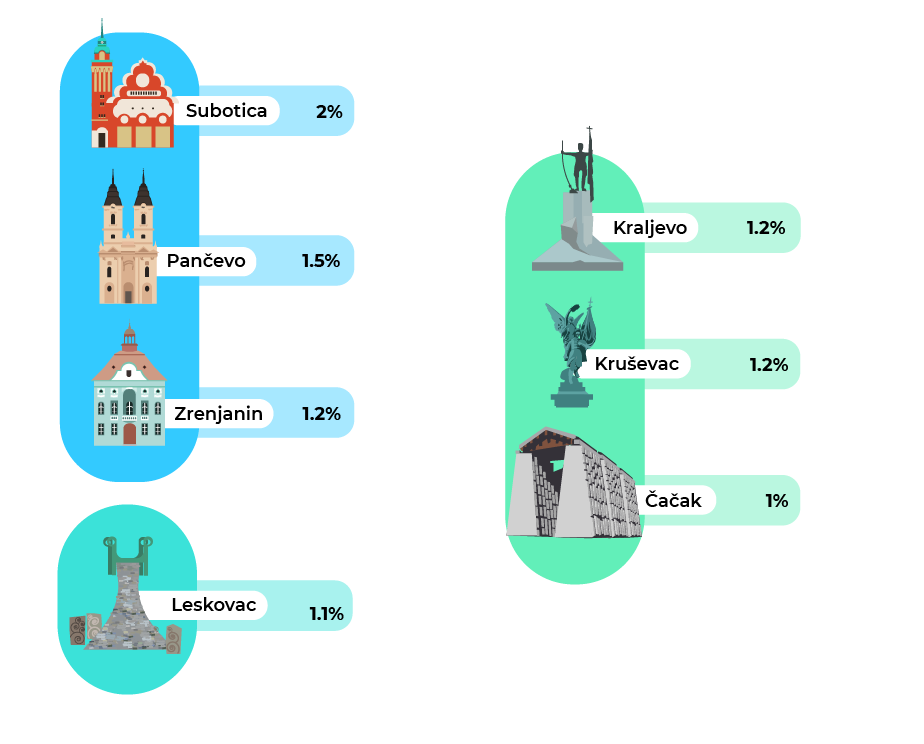
The freelancer population exceeds 1 percent in 11 Serbian cities and towns. Apart from the administrative centres described above, these are Subotica, Pančevo, Kraljevo, Zrenjanin, Kruševac, and Leskovac. Čačak is new to the list, with Sombor now dropping to below 1 percent.
Administrative centres and large conurbations. Data for administrative centres of NUTS2 regions bear out the assumption that gig workers are increasingly concentrated in major conurbations. These changes have been incremental, with centres of the four macro regions home to 64.8 percent of all gig workers, a finding essentially unchanged from the last measurement. Belgrade, however, registered a slight increase in its share in the total, whilst the shares of other administrative centres declined, with Niš registering the largest contraction (at 1pp).
Trends. The urbanisation trend has continued in the latest measurement, albeit at a moderate pace. The freelancer population rose by nearly 1pp in Serbia’s 28 cities and towns. However, the changes have been unequal, with 11 cities and towns seeing their relative shares decline, whilst growth was recorded in most of the others, apart from Kikinda, which remained unchanged. Interestingly, the greatest changes occurred in the largest cities. Here, Niš saw the most pronounced contraction in its share in the freelancer total, at 17.1 percent, whilst the slight growth in Belgrade’s share in the total was accompanied by a significantly larger contraction in freelancer numbers (at 11.5 percent). In other words, the relative increase in importance of Belgrade’s gig workers was the consequence of a more pronounced contraction across other parts of Serbia.
Gender structure and regional differences have seen some changes, driven by the differing rates of contraction registered by freelancers and the somewhat dissimilar trends across genders. What all regions share is the decline of their gig workforces. There has been a contraction in the number of both men and women freelancers everywhere, with the exception of Šumadija and Western Serbia, where the number of women grew by 3.7 percent, but in the remaining three regions the female gig workforce declined less than that of men. Vojvodina saw the largest contraction in women freelancers, with their population in this region falling by 12.6 percent, as opposed to the 18.5 percent decline seen at the same time in men gig workers in Southern and Eastern Serbia.
GIG WORKERS BY OCCUPATION
.

The charts in this report show the distribution of gig workers by occupation according to the Online Labour Index (OLI) taxonomy developed by the Oxford Internet Institute. The six occupations covered are professional services, clerical and data entry, creative and multimedia, sales and marketing support, software dev and tech, and writing and translation.
All occupations registered contractions, albeit with dissimilar features. A minor change was recorded in professional services, where the population declined by 1.8 percent, whilst in software dev and tech workforce contracted by nearly one-fifth (18.1 percent). The least negative developments were seen in the least sophisticated occupations, with clerical and data entry notably registering an increase of 6.1 percent.
This trend can also be viewed through the lens of the increasing impact of artificial intelligence, which has increasingly been replacing jobs that require low to medium coding skills. At the same time, increasing uncertainty in key markets and a global economic slowdown have depressed company demand for these services. Read more ...
Dissimilar contraction and growth trends across occupations. Out of every 100 workers leaving the gig market, 80 came from software dev and tech and creative and multimedia. This finding was only to be expected, since these two occupations are Serbia’s two most popular types of freelance work and the contraction there has been the most pronounced (at 17.5 percent on average). Overall, software dev and tech saw a double-digit decline (at 18.1 percent), as did creative and multimedia (16.9 percent) and sales and marketing support (15 percent), whilst single-digit contraction was recorded in professional services (1.8 percent) and writing and translation (8.8 percent).
Changes in the relative importance of occupations. Tangible differences in the decline in gig workers across occupations have also had some impact on the structure of the market by occupation. The increase in the clerical and data entry workforce, coupled with the decline in other occupations, has made clerical and data entry the third largest sector (with a share of 13.2 percent). The slight contraction in professional services, together with a fairly minor decline in writing and translation, have meant that the relative shares of these occupations have also increased slightly, by 6.5 and 11.1 percent, respectively. By contrast, the shares of the remaining three occupations – creative and multimedia, sales and marketing support, and software dev and tech – has declined by 3.6pp cumulatively, whilst individual shares fell to 34.2, 8.8, and 26.3 percent, respectively.
Restructuring without a clear pattern. The key hallmark of the latest survey is the absence of any clear connection with past developments. Here there are no clear trends that could be unambiguously identified; rather, the changes have been the product of a number of external factors that have caused small-scale and random changes to individual occupations.
REGIONAL GIG WORKERS AS % OF TOTAL, BY OCCUPATION
Although gig workforces have contracted across all regions, Belgrade is still home to by far the largest freelancer population, whose relative share has risen slightly in the latest measurement. The capital city region now accounts for as many as 42 of every 100 Serbian freelancers. Furthermore, the importance of Belgrade-based freelancers has grown in all occupations save for sales and marketing support.
Apart from Belgrade, Šumadija and Western Serbia has shown to be the most resilient in the latest survey. Except for creative and multimedia, all occupations have seen an increase in the relative importance of freelancers based in this region. Growth in the share of writing and translation has also been greater here than in any other occupation or region.Read more ...
Adverse trends were quite pronounced in Southern and Eastern Serbia, with only creative and multimedia and writing and translation seeing an increase. All other occupations registered a decline, except for clerical and data entry, which remained at the level seen in the previous survey.
Gig workers based in Vojvodina left the gig market the most often and in the greatest numbers, resulting in a drop in the region’s relative share across all occupations. This was particularly pronounced in writing and translation, where the workforce contracted the most, not just within the region but also relative to all other parts of the country, for a decline of 3.5pp.
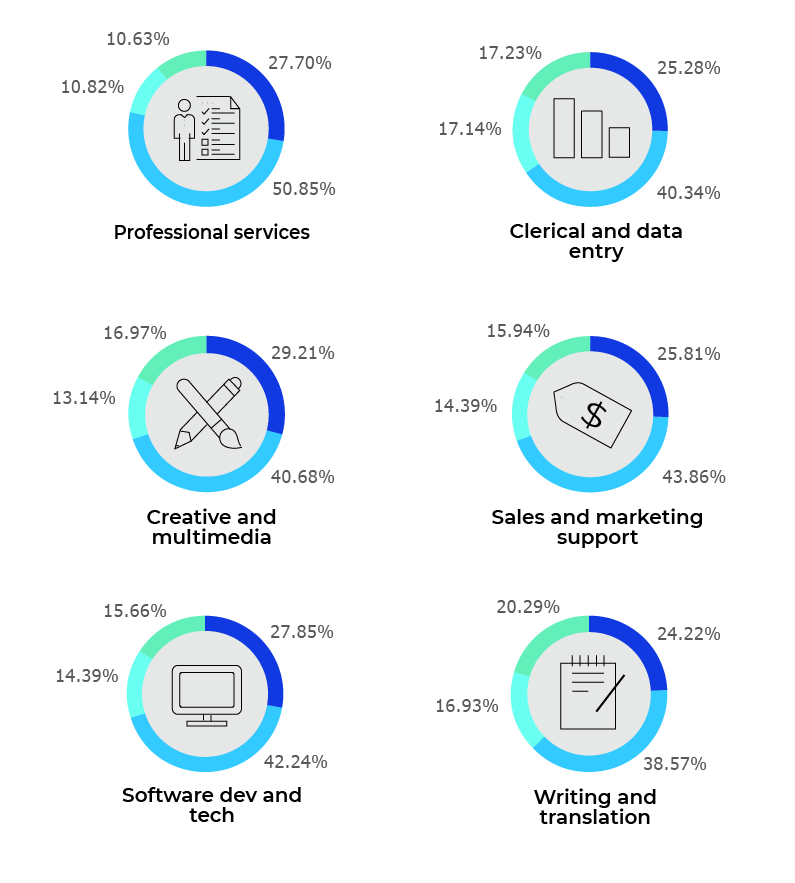
Belgrade has continued to dominate the freelance work market in all aspects. The capital’s shares now range from 38.6 percent in writing and translation to more than one-half of the population in professional services. The combination of dissimilar trends (up or down) of differing intensity (greater or smaller) across occupations has meant Belgrade’s gig workforce has gained in importance. This increase has been apparent in five areas, primarily professional services and creative and multimedia (above 1pp), followed by a less appreciable gain in software dev and tech, with slight improvements seen in clerical and data entry and writing and translation. Sales and marketing support was the only occupation where Belgrade witnessed a drop in its relative importance, but this change was also moderate (at 0.4pp).
Vojvodina was the sole region that recorded a fall in its relative importance across all occupations. Whilst for most of the areas the decline was limited, the gig workforces in writing and translation and clerical and data entry registered the largest decline in their relative importance nationally at 3.5 and 2.5pp, respectively.
Southern and Eastern Serbia is characterised by major differences from both national and other regional trends. Here, three occupations – professional services, sales and marketing support, and software dev and tech – saw their relative importance fall by 1.9, 1, and 1.4pp, respectively, the largest such drop of any region. Conversely, writing and translation registered the greatest relative increase in importance (at 1.1pp), whilst creative and multimedia recorded a modest improvement (0.5pp), and clerical and data entry remained virtually unchanged.
Šumadija and Western Serbia saw its relative share of the gig workforce increase in almost all occupations, with the sole exception of creative and multimedia, where a 1.4pp fall was recorded. By contrast, writing and translation here witnessed the highest single increase in relative importance of any occupation or region, with the share of the regional gig workforce in the total for this sector growing by 2.4pp.

% OF REGIONAL GIG WORKERS BY OCCUPATION
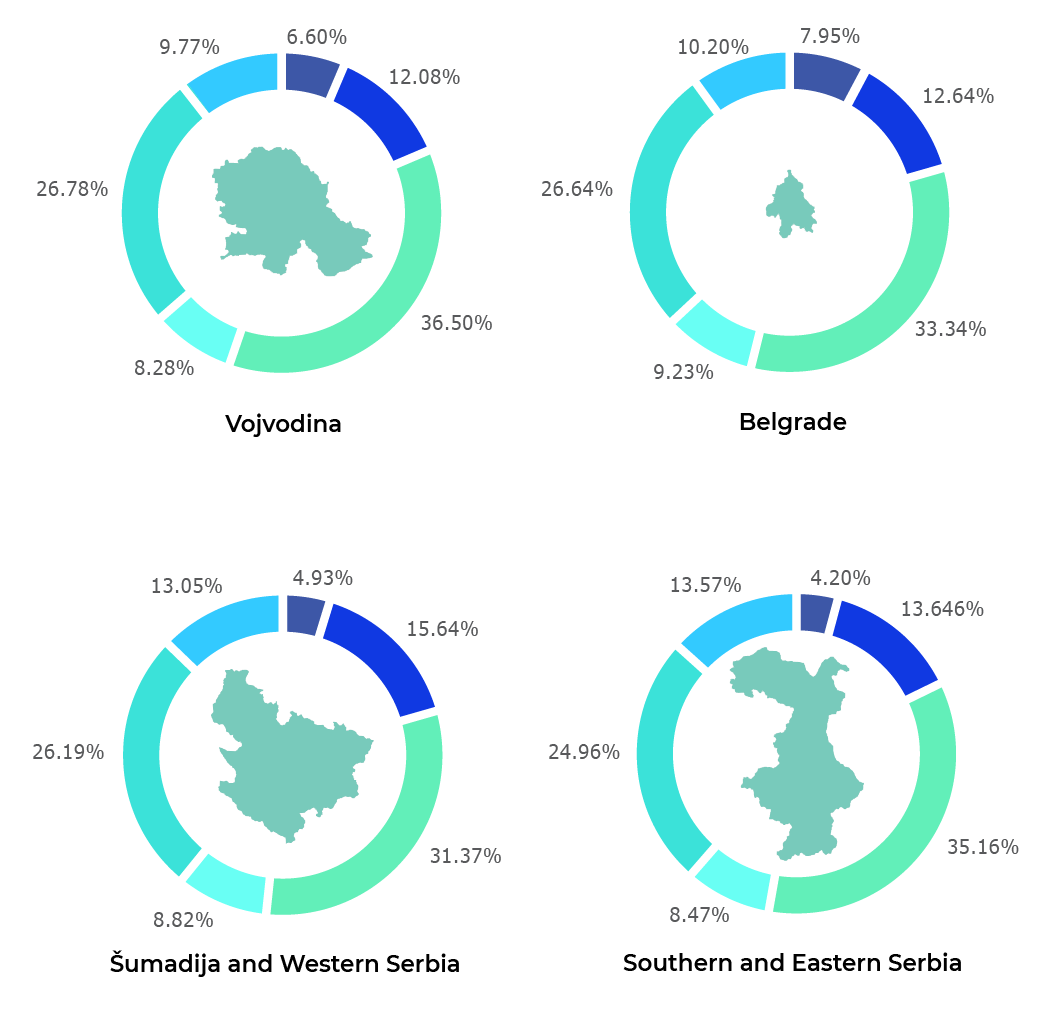
The freelancer workforce has been contracting across all regions, but major regional differences were nonetheless registered. Šumadija and Western Serbia was the sole part of the country where this decline remained in the single digits (at 9.4 percent), whilst Vojvodina suffered the sharpest drop in its gig worker population of 16 percent; this was also the only region where freelancers left the digital work market in all occupations without exception. Read more ...
The supply of freelance labour in Belgrade fell by 11.5 percent, but not all occupations followed the same trajectory. The workforce increased in professional services and clerical and data entry, by 2 and 6 percent, respectively. The remaining occupations declined, with software dev and tech seeing the most dramatic fall of 16.9 percent, whereas writing and translation recorded the smallest drop at 8.8 percent.
Vojvodina was the sole region where the gig worker population fell across all occupations, albeit at uneven rates. A modest contraction was registered in two of the least numerous occupations, professional services (at 4.1 percent) and clerical and data entry (3.7 percent). Conversely, nearly one-fifth of all freelancers in software dev and tech have now left the market, as have more than one-half of those previously active in writing and translation, whilst similar trends were also seen in the remaining two occupations, as creative and multimedia contracted by 17.6 percent and sales and marketing support by 16.4 percent.
Southern and Eastern Serbia saw a substantial decline in its gig workforce, with sales and marketing support and software dev and tech hit particularly hard after one-fifth and one-fourth, respectively, of all workers in the region in these two occupations now having left the gig work market. Significant contractions were also seen in professional services (at 15.9 percent) and creative and multimedia (14.3 percent), whilst writing and translation recorded a moderate drop (at 3.7 percent). The sole positive trend, as in most other regions, was registered in clerical and data entry, where the gig workforce rose by 5.5 percent.
Šumadija and Western Serbia, the smallest region by population, also saw trends that largely differed from those at both the national level and in the other regions. Moreover, this area also registered the highest growth rate in any single occupation, of as much as 21.8 percent. robust growth was also registered in professional services (at 8.9 percent) and writing and translation (5.8 percent). Nevertheless, the contraction here was also more pronounced in the remaining three occupations, driving the overall freelancer workforce down by 9.4 percent, but the decline in the gig population in this region was the smallest nationally.

GIG WORKERS BY GENDER
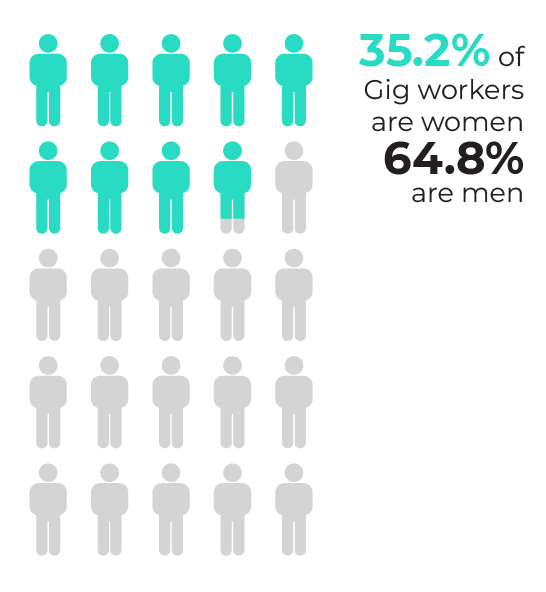
The fairly broad contraction overall has resulted in a similarly broad increase in gender equality. As the number of women workers has seen a smaller drop, their share has increased to 35.2 percent. However, Serbia’s digital labour market has nevertheless remained moderately balanced in terms of gender when compared to other parts of the world, but its women’s participation gap is still pronounced in comparison with the global average of 42 percent.Read more ...
Contraction leads to change. The marked contraction in the freelancer workforce has caused tangible changes to the gender structure of the digital labour market. This decline was uneven for men and women, with the women’s gig worker population falling by 7.4 percent and that of men by a much larger 15.7 percent. These trends have resulted in an increase in the overall share of women in the gig workforce by more than 2pp to 35.2 percent. This share now means that Serbia’s digital labour market is moderately gender egalitarian when the country is compared to its peers or lower-income nations: in Serbia, the women’s participation rate is notably higher than in countries such as Ukraine or Mexico, but also much lower than in Argentina (65 percent) or South Africa (51 percent).
Who has left the market? The decline in the gig workforce has caused some shifts to the relationship between workers with and without platform experience. Here, 63 out of every 100 freelancers now have some experience in platform work, an increase of just above 3pp relative to the previous survey. Inexperienced gig workers, both men and women, were slightly more likely to leave the market. In other words, the online labour market is becoming increasingly focused on experienced workers, whilst new engagements are becoming less easy to maintain, without clear gender distinctions in the process.
% OF GIG WORKERS BY GENDER AND OCCUPATION
The broad contraction of the freelancer population across most occupations has had an impact on gender distribution. Not only have women remained more numerous in clerical and data entry, but they have also become so in professional services due to a 7.7 percent increase in the number of women in this occupation and a parallel 10.6 percent decline in the number of their male peers.
Writing and translation was the sole occupation in which both genders registered an increase, but this was also more pronounced amongst women, whose population grew at four times the rate recorded for men (2.4 percent). In addition, men active in software dev and tech were also more likely to leave the market (at 18.8 percent), whilst the same trend was observed for women in sales and marketing support (at 16.5 percent). Read more ...
Gender equality in sight, but broad gaps remain. The divergence in gender trends across the various occupations, as well as the dissimilar degrees of contraction where it occurred, have promoted gender equality in the digital labour market. The number of occupations dominated by women is now equal to those where men are in the majority as women freelancers have the upper hand in professional services, clerical and data entry, and writing and translation, with shares of 52.6, 53.8, and 52.5 percent, respectively. Conversely, men are more numerous in the remaining three occupations, but the differences there are much more pronounced: women account for 42 percent in sales and marketing support, but men make up 82.8 percent of freelancers in creative and multimedia, and outnumber women by a factor of 7.3 in software dev and tech.
A complex contraction. The population of both men and women freelancers fell across four occupations, but for men the downturn was more pronounced in most except for sales and marketing support. Here, in creative and multimedia, software dev and tech, and writing and translation, the male workforce contracted by an average of 15.9 percent, whilst the number of women fell by 11.5 percent. Women were more likely to leave sales and marketing support, where their numbers fell by 16.5 percent, as opposed to the 13.9 percent for men.
Bucking the trend. Developments in the remaining two occupations diverged from overall trends. Professional services was the sole sector to register both a rise and a fall, with one in ten men leaving the occupation and women seeing a 7.7 percent increase, leading to women gaining the upper hand on men. Conversely, clerical and data entry was the only area that recorded growth across both genders, although women outpaced men by a factor of four as their numbers increased by 9.6 percent in this sector. Clerical and data entry was also the only occupation where women outnumbered men in both absolute and relative terms, with the difference amounting to 16 percent and 110 individuals, respectively.
Differences in the gender structure of occupations are reflected in how men and women are concentrated in the most popular occupations, as well as in the relative significance of these sectors. Here, men account for 7 out of every 10 workers in creative and multimedia and software dev and tech, the two most popular occupations for men, with the share standing at under 10 percent for each of the remaining four occupations. Conversely, creative and multimedia and clerical and data entry were the most popular sectors for women, but these two accounted for just slightly over one-half of all women freelancers. No major differences were seen in how women were distributed across the other occupations: women tended to be less active in software dev and tech (at 9.1 percent), professional services (9.8 percent), and sales and marketing support (16.5 percent). In fact, the contraction has if anything resulted in a better gender balance in the digital labour market; if the downward trend continues, women’s participation in the freelance workforce may stabilise or even increase.
TOTAL INCOME BY GENDER

The cumulative income of Serbian gig workers active in the latest measurement has now reached some US$ 150mn. Women have registered a slight increase in their share of these earnings to 23.6 percent, but this remains far below their share in the total freelancer population. The average cumulative income for women stood at US$ 13,084, nearly 40 percent lower than that of their male peers. This finding testifies to the gender pay gap in the digital labour market, as well as being largely the consequence of the dissimilar hourly rates of men and women and the greater presence of men in better paid occupations.Read more ...
Factors affecting aggregate income. Freelancer income was determined by the interplay of multiple factors acting in concert: the large preponderance of men over women freelancers, which may enhance the effects of sorting; greater concentration of men in better paid occupations; differences in hourly rates, with men on average being able to earn more; greater inclination of women to work part-time; and, lastly, greater than average engagement rate of women (at 33.9 percent), a factor that works in the opposite direction from the remaining ones.
HOURLY RATES, IN US$, BY GENDER AND OCCUPATION
Growth of average hourly rates has decelerated over the past year, and the latest measurement shows they have now fallen by 2.3 percent, or US$0.50. This decline, however, was not sufficient to reverse the impact of growth over the previous six months, and Serbian freelancers have continued to earn more than a year ago, with the average quoted hourly rate standing at US$23.90. In addition, despite the downward trend, gig work allows these freelancers to earn on average US$4.20 above what they would otherwise accept or be able to make elsewhere.Read more ...
Average quoted hourly rates have fallen. Following on from three years of continued income growth, this survey was the first measurement to register a decline in quoted rates, albeit a minor one at just 2.3 percent. Given the high uncertainty in the external economic, regulatory, and tech environment, these trends were primarily driven by demand-side factors, which have seemingly exerted an influence powerful enough to sweep away the wage growth that had been expected to occur due to a contraction in the labour supply. Despite the minimal decline, Serbian gig workers’ quoted hourly rates of US$23.90 still meant they were positioned slightly above the average for other Central and Eastern European countries (at US$23), but lagged by 13.1 percent behind Western European freelancers (who were able to earn US$27 per hour). Major differences were also found between the various occupations. Clerical and data entry freelancers fared the worst, with their quoted rates accounting for no more than 48.4 percent of those commanded by their Western European peers. Conversely, gig workers in software dev and tech and professional services were the best off, as they could make on average 5.5 percent more than freelancers in the same sectors in Western Europe.
Dissimilar income trends across occupations. A key hallmark of the latest survey has been the divergence in trends between occupations, with quoted hourly rates evolving in different directions and at different rates. Professional services and creative and multimedia registered minimal growth, at 0.8 and 1.4 percent, respectively. By contrast, contractions were more pronounced but did not occur in all occupations equally. Writing and translation saw hourly rates fall the most, by 4.8 percent, followed by sales and marketing support, at 3.3 percent. A mode moderate decline was registered in clerical and data entry (at 1.4 percent) and software dev and tech (1.8 percent). A look at changes to average incomes through the lens of labour supply trends suggests a complex web of factors has been affecting outcomes in the digital labour market. Firstly, even though average incomes have been declining (albeit only marginally), labour supply was still able to expand, as has been the case in clerical and data entry, meaning that the desirability of gig work is determined by a broad spectrum of motives and circumstances that go beyond purely monetary incentives. For instance, clerical and data entry freelancers may be induced to join the online workforce by the absence of appropriate alternatives in the traditional job market. However, since any increase or decline was only limited in extent, explanations for these latest trends in the digital labour market should be sought in factors that go beyond monetary incentives, such as personal preference, availability of other work, either hybrid or conventional, or challenges in the labour market itself that may be linked to uncertainty in finding steady employment and other limitations inherent to gig work.
Dissimilar trends by gender and occupation. Women’s average hourly rates fell appreciably more (by 2.6 percent) than those of men (at 1.5 percent). These changes, however, were only minor in scale, and so did not seriously affect gig workers’ aggregate incomes. In spite of the higher average decline in quoted hourly rates for women, these rates actually increased in professional services (by 3.8 percent), clerical and data entry (1.8 percent), and software dev and tech (2.2 percent). Conversely, men’s quoted hourly rates grew at lower rates than women’s, and then only in creative and multimedia (3.1) and sales and marketing support (2 percent).
Gender gaps both closing and widening. Whereas in the previous survey men freelancers were able to earn more than women across all occupations, diverging income trends have now meant the gender pay gap has closed in two occupations. Moreover, women were able to earn more than their male peers, with their incomes being 6 percent higher in clerical and data entry and a minimal 1.1 percent in writing and translation. Even though women were still unable to command greater incomes in professional services, the gap has now closed in that occupation, and has also narrowed in software dev and tech, where women are now able to earn 71.2 percent of their male peers’ quoted average hourly rates. The gender pay gap has widened in creative and multimedia, where women were quoting hourly rates lower by 6.7 percent than those of men, and sales and marketing support, where the disparity has remained exceptionally large and women were able to earn as much as 34.2 percent less than their male peers.
Earnings, potential and real. The interplay of the various changes has led to a widening of the gap in quoted hourly rates, so that women are now able to earn on average 81.6 percent of what their male peers can make from gig work, down from 82.5 percent registered in the previous survey. However, these changes to incomes have not appreciably impacted freelancers’ living standards. Assuming a man worked full time (176 hours) as a freelancer for an entire month, he would be able to make USD$2,230 gross (or US$1,730 net) in clerical and data entry, the least well paid occupation. Conversely, in professional services, the best paid occupation and one where men and women are able to earn identical incomes, the average full time equivalent monthly gross salary could stand at more than US$5,000 (or US$3,840 net). Major differences were found, however, in software dev and tech and sales and marketing support, where men could earn a net salary greater by, on average, slightly more than US$1,000 and close to US$600, respectively.
_____________________________________________________
Recommended citation: Anđelković, B., Jakobi, T., Ivanović, V., Kalinić, Z. & Radonjić, Lj. (2025b). Gigmetar Serbia, October 2025, Public Policy Research Center, http://gigmetar.publicpolicy.rs/en/serbia-2025-2/.
PREVIOUS REPORTS












HOW GIGMETAR WORKS
GigmetarTM is the first instrument that describes the geography of digital work in Serbia and the region in terms of gender, income, and most common occupations. It is a result of the efforts made by the Public Policy Research Centre (CENTAR) to shed more light on the work on online platforms.

ABOUT US
The Public Policy Research Centre (CENTAR) is a team of innovative researchers and digital enthusiasts investigating the future of work and development of the digital economy in Serbia and South-East Europe.
Contact: gigmetar@publicpolicy.rs